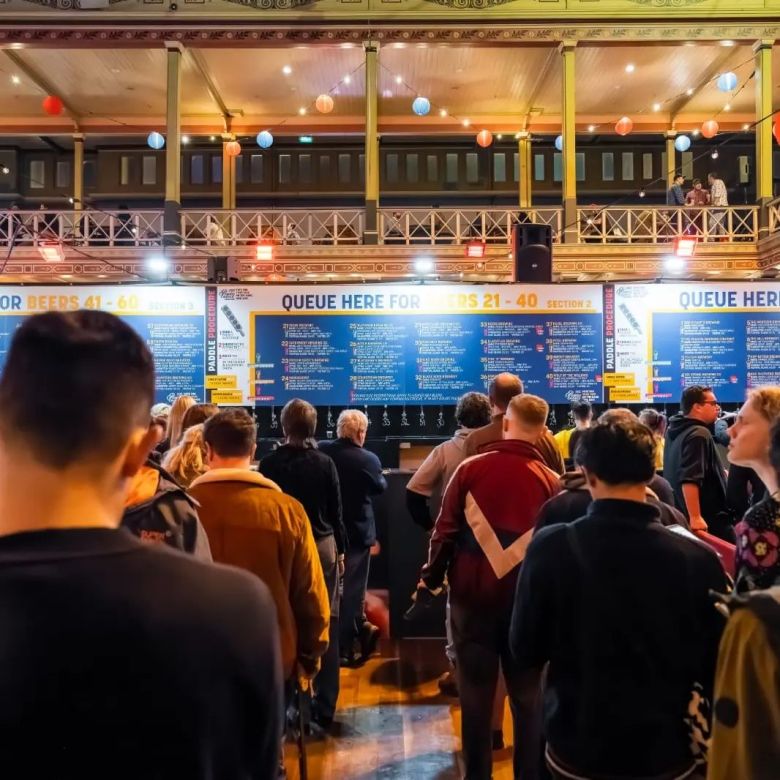
Breweries across the country are using game nights to draw in diverse crowds, welcome new guests, and expand their communities.
The post Bingo! Breweries Score on Game Night appeared first on CraftBeer.com.
Breweries across the country are using game nights to draw in diverse crowds, welcome new guests, and expand their communities.
The post Bingo! Breweries Score on Game Night appeared first on CraftBeer.com.
This week I welcome back Gordon Strong to discuss lager fermentation, lager yeast flavors, judging beer as well as some trends in craft brewing. Subscribe on iTunes to Audio version or Video version or Spotify or Google Play Download the MP3 File– Right Click and Save As to download this mp3 file. Your browser does […]
Adam Mills joins me this week to discuss the use of Thiol boosting yeast, mash hopping and other techniques to enhance the tropical/fruity flavors in IPAs and New England IPAs. Subscribe on iTunes to Audio version or Video version or Spotify or Google Play Download the MP3 File– Right Click and Save As to download […] Quality matters at any size brewery, and the team behind beer quality is what matters most since data doesn’t analyze itself.
The post The People Behind Beer Quality appeared first on CraftBeer.com.
Ken Schramm joins me this week to discuss which fruits work best in meads. Subscribe on iTunes to Audio version or Video version or Spotify or Google Play Download the MP3 File– Right Click and Save As to download this mp3 file. Your browser does not support the audio element. Topics in This Week’s Episode […]
This week I take a look at the Noble hop group which are varieties of hops primarily grown in Continental Europe for use in European lagers and ales. Noble Hops The noble hops group are varieties of hops mainly grown in Central Europe that are characterizes by rich aroma and flavor. They are widely used […] Visiting Denver for the Great American Beer Festival (GABF) tops the bucket list of many beer lovers around the world.
The post 10 Reasons to Attend the Great American Beer Festival appeared first on CraftBeer.com.
Dr Greg Casey joins me this week to discuss the interesting history of German Adjunct Lager and how it influenced the rise of American Adjunct Lager here in the US. Subscribe on iTunes to Audio version or Video version or Spotify or Google Play Download the MP3 File– Right Click and Save As to download […] (CLEVELAND,OH) – Great Lakes® Brewing Co. (GLBC) announces the release of new seasonal Cran Orange Wheat, a fruited wheat ale launching September in 6-Packs and Draft throughout all GLBC markets. […]
The post Great Lakes Brewing Announces New Cran Orange Wheat appeared first on The Full Pint - Craft Beer News.
Pairing produce with beer — with delicious results. A look at the glorious interplay between farmers market fare and craft beer.
The post A Great Beer for Greens appeared first on CraftBeer.com.
This week Skip Schwartz, the head brewer at WeldWerks brewing joins me to discuss brewing barrel aged stouts. Subscribe on iTunes to Audio version or Video version or Spotify or Google Play Download the MP3 File– Right Click and Save As to download this mp3 file. Your browser does not support the audio element. Topics […]
This week I welcome Mirella Amato to discuss how you can best pair beer and foods for a great dining experience! Subscribe on iTunes to Audio version or Video version or Spotify or Google Play Download the MP3 File– Right Click and Save As to download this mp3 file. Your browser does not support the […]
This week I take a look at yeast autolysis which is the decomposition of yeast, and how it affects beer flavor as your beer ages. Yeast Autolysis The word autolysis literally means self-destruction, and yeast autolysis is the final stage for a yeast cell life where the yeast cell wall literally bursts open and releases […] Any beer can be a camping beer, of course, but here are some suggestions for cooling down after a hike or warming up around the firepit.
The post The Great Outdoors: Beers to Enjoy while Camping appeared first on CraftBeer.com.

The ex-Feral and now Found brewer brings the funk with one of his recipes in both all grain and extract form.
The post Recipe of the week: Will Irving’s Golden Brett Ale appeared first on Beer & Brewer.
This week I welcome Larry Horwitz, the head brewer from Crooked Hammock to discuss Wit Beer and Light Lager brewing. Subscribe on iTunes to Audio version or Video version or Spotify or Google Play Download the MP3 File– Right Click and Save As to download this mp3 file. Your browser does not support the audio […] Hops once destined for beer have found a new prominence in hard seltzers, kombucha, and cocktails.
The post New Hope For Hops appeared first on CraftBeer.com.
This week I welcome back John Palmer to discuss English and American Pale Ales and IPAs and how water shapes the flavor of these beers. Subscribe on iTunes to Audio version or Video version or Spotify or Google Play Download the MP3 File– Right Click and Save As to download this mp3 file. Your browser […] Back Home Beer brings to life Iranian and Middle Eastern ingredients and flavors, and celebrates the communal joy of brewing and bonding with one another over beer.
The post Transporting Beer Drinkers ‘Back Home’ with Middle Eastern Flair appeared first on CraftBeer.com.
This week I welcome back Stan Hieronymus to discuss New Zealand hops, new hop varieties and their application in India Pale Ales. Subscribe on iTunes to Audio version or Video version or Spotify or Google Play Download the MP3 File– Right Click and Save As to download this mp3 file. Your browser does not support […]
This week I welcome Rick Goehring from Walnut River Brewing who shares an interesting story of starting a production brewery with very little money. Rick has the top selling Kansas produced Craft Beer now. Subscribe on iTunes to Audio version or Video version or Spotify or Google Play Download the MP3 File– Right Click and […] The Brewers Association Mentorship Program has successfully finished four cohorts. Selected participants complete a 12-week program with mentors from various parts of the industry.
The post Pursuing a Passion: Mentorship Program Fuels Participants appeared first on CraftBeer.com.
This week I welcome Jamil Zainasheff back for another brewing question and answer session. Jamil covers a wide variety of topics from Hazy IPAs to the state of homebrewing. Subscribe on iTunes to Audio version or Video version or Spotify or Google Play Download the MP3 File– Right Click and Save As to download this […] These five U.S. breweries all make good beer. But for folks who have been there, they know that they’re in for an experience that doesn’t stop there.
The post Five Unique Places to Drink a Beer appeared first on CraftBeer.com.
This week I take a look at some of the key process factors when lautering and sparging your all grain beer. Last week in part one, I discussed equipment design and how a filter bed forms around grain husks and creates channels that the wort flows through. I explained why a poorly designed lauter tun […] Thiols are sulfur-containing compounds that are often potent aromatics. The ones brewers are excited about are tropical, winey, and citrusy, while other thiols are intensely unpleasant with aromas of garlic or rotten eggs... which is why the thiol mercaptan is added to natural gas to alert people to leaks. The "skunky" aroma of light-struck beer is also 3-methyl-2-butene-1-thiol.
Unlike many other beer aromatics that require concentrations in the ppm (parts per million) or ppb (parts per billion) many thiols have an aroma threshold in the range of 5-70 ppt (parts per trillion). This means that it doesn't take much of them to be apparent, but also means that it doesn't require "high" concentrations to become dominant.
In terms of positive beer and wine aromatics, the thiols that get the most attention are 4MMP, 3MH, 3MHA, and 3S4MP. These have perceptions that range from passionfruit, to grapefruit, to rhubarb. These are the intense aromatics that give New Zealand Sauvignon Blanc wines their distinct aromas and are found free at low-levels in many New Zealand hops (as well as some other varieties from around the world).
Most of the thiols found in hops, malt, and other botanicals are bound and thus not active aromatically. Enzymes are required to free them. There are wine strains available capable of this, but getting those genes into brewer's yeast requires more work.
Bound thiols are found in both malt and hops, but levels vary widely. The bond in need of breaking comes in two "flavors" Cysteinylated (Cys) and Glutathionylated (Glu). The vast majority (90%+) in both malt and hops is Glu. The IRC7 gene in certain wine strains and Omega's Cosmic Punch can only work on the less common Cys. As a result, mash hops are most potentially beneficial for Cosmic Punch, as the enzymes in the mash (especially in the acid-protein rest temperature range) can help convert Glu to Cys. Luckily some less expensive hop varieties have the highest levels of bound thiols. We've used Saaz, Cascade, and Calypso with good results.
The more intense strains like Berkeley Yeast Tropics line and Omega's Helio Gazer, Star Party, and Lunar Crush can simply be added to a standard recipe with or without whirlpool hops. Rather than having more copies of the IRC7 gene, they have a wholly different gene which can free Glu-thiols directly. The IRC7 gene in Cosmic Punch is "sourced" from yeast, while patB Omega uses in the more assertive strains is from a bacteria (if transgenic CRISPR/Cas9 gene modification is a step too far for you). We fermented a kettle sour which only had a small dose of hexalone (isomerized hop extract for head retention) with London Tropics. The result was intensely passion-fruity, so much so that it could almost pass a fruit beer.
GM (genetically modified) yeast strains aren't allowed in commercial beers in many countries (e.g., Canada, New Zealand). As a result there are labs working with wild isolates capable of freeing thiols for co-fermentations (e.g., CHR Hansen - it is primarily marketed for NA beers) and breeding strains with heightened thiol freeing capabilities (e.g., Escarpment). Omega initially worked on yeast breeding between English ale and a wine strain capable of freeing thiols... our trials with it (Designer Baby) were interesting, but had too much of the wine strain's idiosyncrasies present (poor flocculation especially).
Pros:
-Intense aromatics that are otherwise impossible to achieve from hops, malt, and yeast
-Thiols have incredibly low aroma thresholds... measured in ppt (parts per trillion)
-Thiols are "free" no expensive hops or fruit required
-Thiols may help increase shelf-life by scavenging oxygen
Cons:
-Higher perceived "sulfur" aromatics are frequent in thiol-freeing strains
-Some brewers/consumers/countries prefer to avoid GM ingredients
-Thiols can be "one note"... is it really that different from adding a jar of passion fruit extract?
-Repitching the yeast doesn't make as much sense if you also want to brew English Ales, Porters/Stouts etc.
Initially there was a focus on maximizing thiol concentration. This could include colder fermentation temperatures, mash hops, and engineering strains with more assertive genes. Like most aspects of brewing (or cooking) maximizing a single flavor compound doesn't usually result in the best overall flavor or balance.
Thiols aren't typically a "primary" aromatic in beer, so a beer with over-the-top thiol concentration without anything to play off of can taste artificial. On the other hand, some of our heavily dry hopped DIPAs have tested at over 100X the flavor threshold for 3MH and still weren't the primary aroma thanks to competition from the "traditional" hop aromatics. From those test, I wouldn't worry about dry hopping removing all of the thiols.
As a general rule, I'd suggest using a more restrained approach to thiols in lighter/cleaner/simpler beers. It doesn't take much to add a unique twist to a lager or American wheat, where a double-dry-hopped DIPA or fruit beer may benefit from a much higher amount. In the end it's about your palate and goals for a beer.
In my experience expressing thiols doesn't make every hoppy beer better. They add a distinct note that can greatly enhance the perception of passionfruit-type aromatics. That is a wonderful contribution when you are leaning into those flavors, but can be distracting or muddle other flavors. For example, I love the "mango popsicle" aroma of great Simcoe. However, with one of the intense strains like London Tropics or Helio Gazer in an all-Simcoe beer can become more generically "tropical" rather than varietal "mango." On the other hand, when dry hopping with passion-fruity Galaxy, or brewing with actual passionfruit the thiol note helps to enhance the existing aromatics.
Hand-in-hand with thiol-expressing yeast goes Phantasm. It is essentially the dried and powdered remnants of the highest-thiol New Zealand Sauvignon Blanc grapes. As a result it comes with a high price-tag of ~$35/lb. It really doesn't smell like much before fermentation. Added to the whirlpool it adds a huge amount of bound thiols for the yeast to work on.
During fermentation I detect a distinct "white grape" flavor and aroma that I don't get from other thiol-expressing ferments that rely on grain and hops alone for bound precursors. A lot of this drops out with the yeast however and the finished beers are rarely as distinct. To my palate the added expense is hard to justify in a highly-dry-hopped beer where the thiols are competing against other big aromatics. Unless you lean into those aromatics with a hop like Nelson Sauvin. I like Phantasm best when it is paired with actual white wine grapes, or in a simple base where it can star.
We haven't used Berkely Yeast's "Thiol Boost" additive yet... but I'm just not that excited about a 15X increase on the already intense London Tropics level of 3MH. I'd be interested in herbs or additives that could push other unique thiol aromatics that we aren't getting from grain/hops.
At Sapwood Cellars, we've brewed a few dozen batches between Cosmic Punch, London Tropics, Lunar Crush, and experimental isolates. I've enjoyed most of them, but a handful stand-out as beers I loved!
Cosmic Rings: Galaxy and Citra is one of our favorite combinations... but we have had a difficult time sourcing great Galaxy (that doesn't taste like honey roasted peanuts). This all-Citra double-dry-hopped pale ale starts with New Zealand Taiheke (Cascade) in the mash and kettle. It's one of our favorite whirlpool hops because it is low alpha acid and has a beautiful tropical aroma... not to mention a lower price compared to other New Zealand varieties like Nelson Sauvin and Riwaka. Then we ferment with Omega's Cosmic Punch which brings some tropical aromatics without becoming distracting or artificial. Finally we dry hop with Citra and Citra Cryo at a combined 3 lbs/bbl.
Tropical Pop: Kettle sour fermented with Berkeley Yeast London Tropics along with passion fruit and mango purees. Passion fruit is expensive, fermenting with London Tropics boosted the passion fruit aroma allowing us to use less without sacrificing the aroma intensity.
Field Learning: As a homebrewer I loved being able to dump a bottle of thiol-rich New Zealand Sauvignon Blanc into a keg of mixed-ferm saison. That wouldn't be legal commercially, but what we did for this collab with Bissell Brothers was to brew a restrained base with Hallertau Blanc in the mash and Phantasm in the whirlpool and age it in fresh Sauvignon Blanc barrels along with Bissell's house culture. After a year we added fresh Chardonnay grapes from Crow Vineyards here in Maryland. The tropical notes from the thiols survived barrel aging and gave the beer depth we wouldn't have gotten from grapes and barrel alone.
Are thiols a scam? No, but they also aren't an innovation that fundamentally changes what it takes to make a delicious beer. Consider a thiol-freeing yeast when additional passionfruit-type aromatics will enhance your beer. Don't worry about maximizing the thiols unless you they will be competing against other strong aromatics.
I suspect that this is just the lead in to even more exotic genetically modified yeast strains (we have a pitch of Berkeley's Sunburst Chico which is modified to express high levels of pineapple-y ethyl butyrate). If you can produce a flavor compound without the cost, environmental impact, variability of growing it I suspect the economic pressures will be too great! That said, making delicious beers isn't about maximizing one or two compounds (in the same way that vanilla flavoring is inexpensive, but doesn't fully replace the depth and complexity of real vanilla beans).
This week I take a look at the process of lautering or sparging your all grain beer. What appears to be a simple process actually has some interesting complexities to it. Lautering Lautering would appear to be one of the simplest steps in all grain brewing. Hot water is run through the grain bed to […]