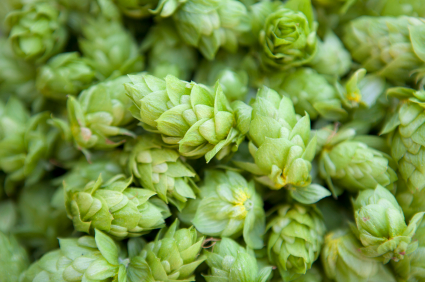

This week I take a look a the major role thiols play in selecting hops for beer brewing, and also examine the difference between free and bound hop thiols.
Thiols in Hops
While thiols from grapes have long known to play a central role in wine making, only in the last 10-15 years have the importance of thiols derived from hops in beer brewing come to light. In particular the rise of IPAs in Craft brewing and introduction of fruity IPA styles like Hazy/New England IPAs have driven a lot of experimentation and research into hop thiols.
Thiols are chemically a sulfur based version of alcohol. Alcohol molecules have an -OH group in their structure, but thiols replace that group with an -SH group. In hops, thiols make up a fraction of 1% of the overall aromatic hop oils, and aromatic hop oils themselves are only 0.5-4% of a dried hop cone. However, thiols pack a big punch for their size as the human nose can detect them at levels of nono-grams per liter!
While there are many forms of thiols in hops, brewers tend to focus on the “big four” thiols which make up the majority of the thiol aroma oil. Thiols are associated with desirable fruity aromas in the finished beer:
- 4MSP or 4MMP (4-mercapto-4-methyl-pentan-2-one) – Has the aroma of Boxtree, Ribes, Chives, Tomato plant and Blackcurrants
- 3MHA or 3SH (3 mercaptohexanol) – Aroma of Grapefruit, Citrus, White Grape and Gooseberry
- 3S4MP or 3M4MP (3-mercapto-4-methylpentan) – Passion fruit, Grapefruit and Rhubarb
- 3MHA or 3SHA (3-mercaptohexyl acetate) – Converted to 3MH during fermentation, and can also produce beta-lyase during fermentation – Aroma of Passion fruit and Guava.
I wrote a separate article on hop thiols here which is a good reference if you want to understand more about them.
Free Versus Bound Thiols and Yeast Selection
Hop thiols exist in two forms, free and bound. Bound thiols are chrmically bound to amino acids. Free thiols are aromatic from the start, but bound thiols are odorless. During fermentation, some bound thiols can be freed in a process called biotransformation. The free thiols are aromatic, but unfortunately most yeast strains do not do a good job of freeing the non-aromatic bound thiols. Bound thiols are bound to amino acid precoursors that require a specific desulfhysrase β-lyase enzyme to free them.
Many yeast strains have a specific gene called IRC7 that promotes the β-lyase enzyme to release thiols when present, but unfortunately most natural yeast strains have a mutation that effectively disables the gene, rendering it ineffective or only weakly effective. Yeast labs have focused on this problem however, and many labs are now offering genetically modified yeasts that work well on bound thiols.
Omega yeast was one of the first to launch so called thiolized yeast strains with their Cosmic Punch OLY-402 strain. They have since added variations like Start Party, Lunar Crush and Helio Gazer which are all genetically modified yeast strains designed to activate the IRC7 gene to free more thiols. Other yeast labs have followed suit with Berkeley yeast offering their “Tropics” line including London, Vermonth and Andechs yeast strain. Escarpment lab also has a strain called Thiol Libre.
For those who want to avoid genetically modified yeast, White Labs has their Tropical Yeast Blend (WLP-077) which is a non-GMO yeast blend designed to release bound thiols, and Lallemand did a study showing that their Lalbrew Diamond, Farmhouse, Nottingham, Voss and Verdant strains release some bound thiols.
I wrote an extensive article for BYO Magazine recently covering the use of mash hops to enhance thiols which is an emerging technique. Using a modest amount of hops in the mash along with a thiolized yeast strain can actually result in more free thiols in the finished beer.
Choosing Hops for Thiol Impact
Lallemand produced a chart showing the hop varieties highest in thiol content here. I’ve included an extract below:

Hops with high levels of free thiols:
- 3SH/3MH (Grapefruit): ApolloTM, Galaxy®, Simcoe®, Citra®, Mosaic®
- 3S4MP/3M4MP (Rhubarb): Nelson SauvinTM, Ekuanot®, Hallertau Blanc, Mosaic®
- 4MSP/4MMP (Black Currant): Nelson SauvinTM, ApolloTM, Citra®, Galaxy®, Mosaic®, Simcoe®
- 3SHA/3MHA (Passionfruit): None
Hops with high levels of bound thiols:
- 3SH/3MH (Grapefruit): MotuekaTM, Saaz, Cascade, Citra®, Hallertau Blanc
- 3S4MP/3M4MP (Rhubarb): Hallertau Blanc
- 4MSP/4MMP (Black Currant): Nelson SauvinTM, Aramis, Strisselspalt, Mandarina Bavaria, Simcoe®
- 3SHA/3MHA (Passionfruit): None
Separately Scott Janish published a blog post here highlighting the work of Aurealie Roland on bound concentrations of thiols. Scott noted that 3MH/3SH makes up the bulk of the bound thiol aroma oil concentration in most hops, and that many of these hops also had other thiol precursors. So selecting hops that are high in 3MH/3SH either in free or bound form listed above may be a good option.
To encourage the biotransformation that free’s bound thiols most brewers add their high-thiol hops in the whirlpool. You can also add them to the mash in moderate quantities as mash hopping along with thiol-boosting yeast has been shown to increase free thiols in the finished beer. The BYO article I mentioned covers mash hopping in detail.
I hope you enjoyed this quick overview of thiols and brewing. I encourage you to read my full BYO article on mash hopping and thiols as well as my blog post on thiols to learn more. Thanks for joining me on the BeerSmith Home Brewing Blog. If you want to take the guesswork out of brewing, please try my BeerSmith 4 recipe software from BeerSmith.com. Be sure to sign up for my newsletter or my podcast (also on itunes and youtube) for more great tips on homebrewing.